
Founder & CEO of Eurodita
Rolanas Kutra founded the Eurodita timber-building business, whose manufacturing history began in 1994, and has led it ever since. More than thirty years in timber construction stand behind the way Eurodita works today: a B2B private-label manufacturer of log cabins, residential timber buildings, bespoke structures and glulam homes, supplying partners who sell under their own name.
He built the main dealer, distributor and private-label partnerships that Eurodita works with, and he still spends most of his time with them: on specification, on bespoke and glulam projects, and on the questions that decide whether an order runs cleanly through the factory.

At a glance
How Rolanas works with partners
The partnership model is simple to state and demanding to run: Eurodita manufactures, the partner sells under its own name, and Eurodita stays behind the scenes. The partner manages its own sales, pricing and customer relationship; partner-branded quotation and project documentation can be provided where agreed.
Before a first order, Rolanas settles the points that later cause the most friction between a seller and a manufacturer.
Intended use, site, layout, openings and required documents are discussed before production scope is treated as settled.
Solid walls in 19, 28, 34, 44, 58 and 70 mm, glulam walls in 70, 88, 135, 180 and 220 mm. A solid log model can be made in any of the 28, 34, 44, 58 and 70 mm profiles, and a glulam model in any glulam profile to suit the project and budget. Wall profiles
The dimensions given for each model are external, so partners compare like with like against other suppliers.
Factory scope is agreed per project; supply is EXW unless agreed otherwise, with freight confirmed per order.
Samata: quoting built for dealers
Rolanas had Samata built inside Eurodita because he watched distributors lose bespoke deals while they waited for a quotation. A customer who sketches a building wants to see it before the idea cools. Samata turns a partner's brief into 3D renders, technical drawings and a material specification, so the partner can put a visual and a written offer in front of the customer under its own brand.
The same discipline runs through the rest of the order: a controlled brief, an approved drawing set for the particular order, and a clear line between what the factory supplies and what the local project team handles. Bespoke timber buildings
Eurodita in figures
- About 12,000 standard catalogue timber buildings a year on average.
- 1,800 to 2,000 bespoke structures a year on average, glulam excluded.
- About 50 glulam homes over 100 m² a year on average.
- About 5,000 m² of covered production space at the Eurodita factory in Lithuania, with Hundegger CNC machining, in-house kiln drying and own timber windows and doors.
Recognition
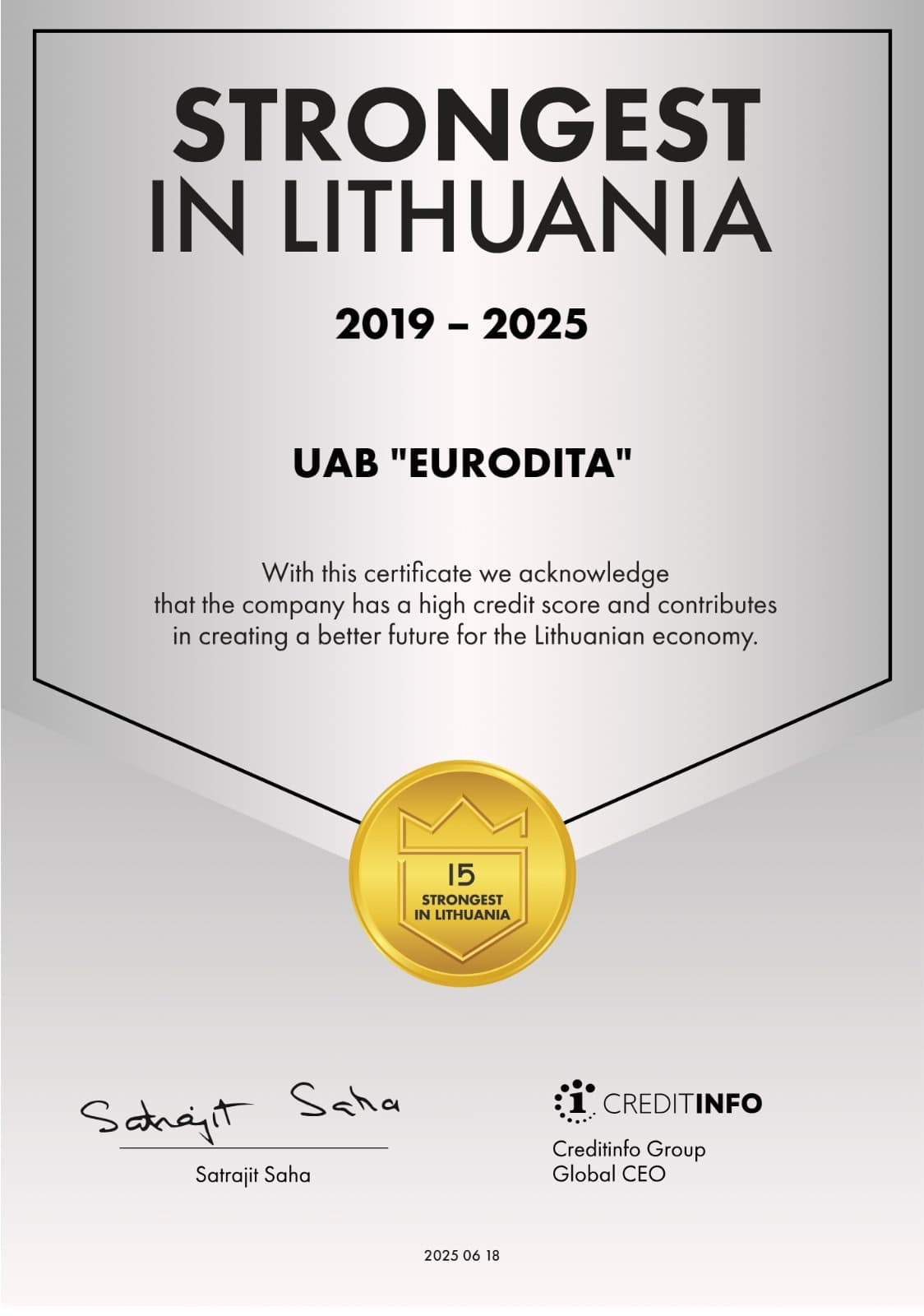
Rolanas Kutra is a member of the Forbes Business Council. The company he leads holds the Creditinfo and Okredo ratings shown below.


In his words
"A custom timber building should not reach the factory as a good-looking idea with unresolved interfaces. [...] A sketch can start that conversation. A controlled brief is what allows it to move forward."
Rolanas Kutra, on LinkedIn
Talk to Rolanas and the Eurodita team
Dealers, distributors, developers, holiday-park operators and private-label brands can start with a short brief: the building type, dimensions, destination and the documents the project needs. The Eurodita sales team replies with the next step, and Rolanas joins the conversation on partnership and bespoke projects.