
Glulam (glued laminated timber) and traditional solid log construction differ in structural performance, dimensional stability, and price point. Glulam provides engineered dimensional stability and can support wider-span or higher-duty briefs when the project specification requires it. Traditional solid-log construction remains the simpler, lower-cost route for standard garden, leisure and many bespoke cabin projects, with settling and technical review handled in the normal specification process.
What Is Glulam Timber? (Definition)
Glulam (glued laminated timber) is an engineered wood product: laminating spreads natural defects across several layers, so its properties are more uniform than a single solid log, it can be made in larger sections, and it typically settles and moves less. Traditional solid log construction is usually the lower-cost route, and its settlement is allowed for in the detailing. Glulam is often chosen for residential and commercial builds and for larger spans, and what a particular structure needs is confirmed by the project’s structural engineer.
What Is Traditional Solid Log Construction?
| Feature | Standard non-glulam log cabins | Glulam projects |
|---|---|---|
| Wall thickness range | 28mm, 34mm, 44mm, 58mm, and 70mm, with 19mm used for sheds | 88mm, 135mm, 180mm, and 220mm |
| Technical basis | Standard catalogue and bespoke log-cabin specifications | Engineered timber specification confirmed per project |
| Thermal review | Depends on the complete floor, roof, glazing, insulation, and installation package | Depends on the complete project specification and local-authority review |
| Commercial handling | Quoted from the confirmed catalogue or bespoke brief | Quoted from confirmed drawings, scope, and engineering requirements |
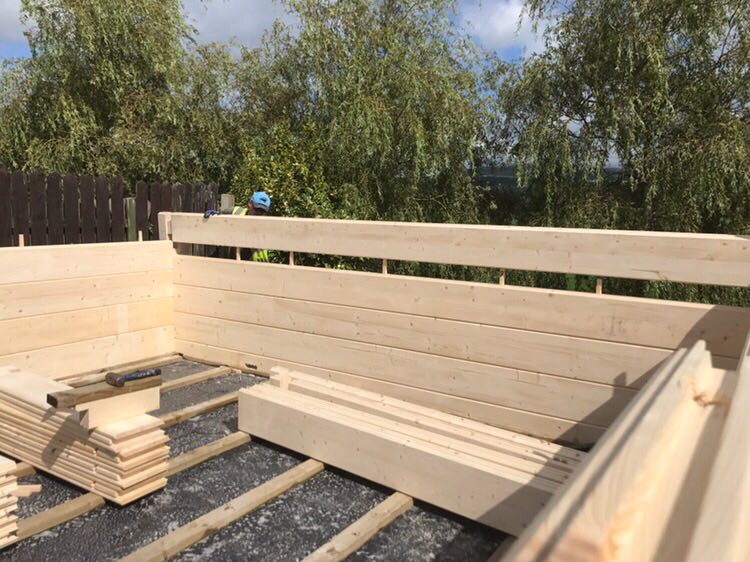
Traditional solid log construction uses single-piece logs milled to uniform thickness and stacked horizontally, with profiled joints (dovetail, square notch, or tongue-and-groove) between courses. This is the oldest form of timber building and remains the dominant construction type for entry-level and mid-range garden buildings, cabins, and holiday structures worldwide.
Eurodita’s log cabin range uses Northern European timber. Standard non-glulam wall profiles include 19mm sheds and 28mm, 34mm, 44mm, 58mm and 70mm log-cabin walls, with bespoke log-cabin specifications confirmed per project.
Key Differences: Structural Performance
| Property | Glulam projects | Standard non-glulam log cabins |
|---|---|---|
| Profile range | 88mm, 135mm, 180mm, and 220mm | 28mm, 34mm, 44mm, 58mm, and 70mm, with 19mm used for sheds |
| Specification route | Confirmed from project drawings and technical requirements | Confirmed from catalogue or bespoke log-cabin brief |
| Project review | Suitable for dealer, architect, or local-authority technical review where required | Suitable for standard garden, leisure, and bespoke cabin applications depending on the final brief |
Key takeaway for dealers: For any structure intended as a residential building, commercial space, or multi-storey application, glulam is a common choice, and its engineered specification is easier to explain to end customers who research before buying.
Key Differences: Thermal Performance
Thermal performance is project-specific and should be assessed from the complete wall, floor, roof, glazing, membrane, and insulation build-up, not from wall thickness alone.
| Specification area | Dealer review point | Eurodita support |
|---|---|---|
| Wall profile | Confirm whether the project uses standard non-glulam profiles or glulam profiles | Technical data supplied for the selected product line |
| Thermal package | Assess wall, floor, roof, glazing, membranes, and insulation together | Project-specific data supplied for dealer and local-authority review |
| Use case | Check seasonal, workspace, accommodation, or residential expectations against local rules | Eurodita manufactures to the client-approved project specification |
Note: Eurodita supplies technical data for dealer and project review. Final thermal or residential-use suitability depends on the full specification and local authority review.
Key Differences: Price and Margin
| Commercial factor | How dealers should compare options |
|---|---|
| Manufacturing scope | Compare confirmed drawings, wall profile, glazing, insulation, packaging, and logistics. |
| Pricing | Use Eurodita project quotes instead of fixed public price bands. |
| Margin | Set by the dealer in its own market; Eurodita quotes the wholesale price only. |
Key takeaway: Glulam should be positioned as an engineered project specification, not as a fixed-price upgrade. Dealer pricing and margins are the dealer’s own decision, made against the confirmed design, materials, logistics and wholesale quotation.
Which Type Sells Better in Each Market?
- UK: Solid log dominates the volume garden office and garden building market (28-70mm). Glulam is growing rapidly in the residential and year-round office segment. Dealers should stock both.
- Germany: Glulam (Brettschichtholz) has strong market penetration in residential and commercial timber buildings. German buyers are more technically literate and respond well to specification selling. Solid log is sold predominantly in the garden building and holiday cabin segment.
- Scandinavia: Strong cultural preference for traditional log construction (especially Norway and Sweden for holiday cabins). Glulam dominates commercial and large residential projects.
- Netherlands/Belgium/France: Predominantly garden building segment; solid log in 44-70mm dominates. Glulam is a niche but growing.
Dealer Use Cases: When to Recommend Glulam vs Solid Log
- Recommend standard non-glulam log cabins when: the project brief is for sheds, garden buildings, seasonal cabins, or standard catalogue cabins.
- Recommend glulam when: the brief requires engineered timber profiles, larger project-specific structures, or a technical package for dealer, architect, or local-authority review.
- Use glulam as a specification route: compare it against the project requirements, expected use, technical review needs, logistics, and final quote rather than a fixed percentage uplift.
Eurodita’s Glulam vs Solid Log Range
Eurodita manufactures both product types from Kaunas, Lithuania, using Northern European timber. Wall thickness options are specified by product line:
- Standard non-glulam log range: 28mm, 34mm, 44mm, 58mm, 70mm, with 19mm used for sheds
- Glulam range: 88mm, 135mm, 180mm, 220mm
Eurodita prepares the complete quotation, CAD, 3D visualisation and technical drawing package per enquiry after receiving a complete brief. All products are available on a private-label basis, with order scope confirmed in each quotation.
Frequently Asked Questions
Is glulam stronger than solid log?
u003cpu003eNot by a fixed percentage. Strength depends on the grade of the timber and the design, not on the product name. Glulam’s advantage is consistency: laminating spreads natural defects across several layers, so its properties are more uniform than a single solid log, it can be made in larger sections, and it typically settles and moves less. What a particular structure needs is confirmed by the project’s structural engineer, not inferred from the profile size.u003c/pu003e
Does solid log settling cause problems?
u003cpu003eOnly if it is not allowed for. Solid log walls settle as the timber dries and the courses compress, so windows and doors need settlement gaps above their frames, and stairs, services and internal fixings need details that let the walls move. Drier timber moves less after assembly: Eurodita’s production moisture target for wall timber is approximately 12 to 14%. Glulam typically settles far less than solid log, though its detailing still needs care.u003c/pu003e
Which is better for year-round use, glulam or solid log?
u003cpu003eEither can work, because the complete building decides it rather than the wall material alone. Glulam’s thicker laminated sections, 88, 135, 180 or 220 mm, put more timber in the wall and are chosen where stability matters. Solid profiles, up to 70 mm, usually need an added insulated layer, sourced locally, for heated, year-round use. Suitability then depends on the floor, roof, glazing, insulation and ventilation, and on any local-authority requirements.u003c/pu003e
What does glulam cost compared to solid log?
u003cpu003eThere is no fixed percentage difference. Glulam, like bespoke and modified projects, is calculated individually for each project, so compare options on the same confirmed drawings: wall profile, roof and floor, joinery, logistics and your private-label commercial terms. The written quotation, priced EXW Kaunas with VAT and delivery excluded unless it states otherwise, gives you the like-for-like figure.u003c/pu003e
Related reading: Browse Eurodita’s Glulam Homes Range | Browse the Solid Log Cabin Catalogue | Log Cabin Building Regulations UK 2026