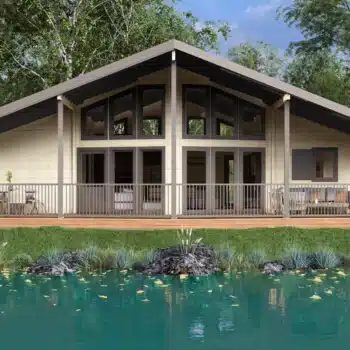
The global log cabin and timber cabin market is worth $10.61 billion in 2025 and is projected to reach $11.2 billion in 2026 â a compound annual growth rate of 5.6% (The Business Research Company, 2026). Within that global picture, Europe is the single most structurally significant region, underpinned by centuries of timber-building tradition, tightening green-building regulation, and a post-pandemic shift in consumer behaviour that is still driving demand for outdoor and countryside structures into 2026.
For B2B dealers â whether you sell garden rooms in the UK, leisure cabins in Germany, or glamping units in Scandinavia â understanding where the market is headed is the difference between reactive purchasing and strategic inventory planning. This post consolidates the most current market intelligence available as of Q2 2026.
Key Market Facts (2025â2026)
Quick-reference data box for buyers and dealers
- Global log cabin & log home market value (2025): $10.61 billion â growing to $11.2 billion in 2026 (The Business Research Company)
- Global market CAGR to 2030: 5.6% (TBRC, EIN Presswire, January 2026)
- Europe timber construction market value (2024): $5,568.8 million â forecast to reach $12,830.9 million by 2033 (Grand View Research)
- Europe timber construction CAGR (2025â2033): 9.8% (Grand View Research)
- Global garden rooms market value (2026): $3.56 billion â growing to $5.4 billion by 2030 at 11% CAGR (Research and Markets)
- UK garden room market (2024): £266 million â CAGR of 5.8% through 2030 (Stirling Ackroyd / industry data)
- Global glulam (engineered timber) market (2024): $7.8 billion â CAGR of 5.2% through 2034 (GM Insights)
- Lithuania wood carpentry exports (2024): $372 million â top destinations Germany ($61.6M), UK ($60.6M), Norway ($47.7M) (Observatory of Economic Complexity)
European Market Overview
Europe’s timber construction sector is on a structural growth path driven by regulatory pressure, consumer preference, and the economics of prefabrication. Grand View Research values the European timber construction market at $5.57 billion in 2024, with a projected CAGR of 9.8% through to 2033 â one of the fastest growth rates of any building materials segment on the continent.
No minimum order. Private-label ready. 200+ active dealer partners across 38 countries.
Request your B2B price list →
Log cabins and timber cabins sit within this broader category, representing the residential, leisure, and garden-building subsegment. The DataInsightsMarket report on log cabin buildings estimates the global segment at $4.72 billion in 2025, with a CAGR of 6.6% â meaning Europe, as the dominant consuming region, accounts for an estimated 35â40% of global demand.
The market is not monolithic. Three distinct product segments are driving European volume in 2026:
1. Leisure and holiday cabins â glamping, holiday parks, rural retreats 2. Garden buildings and offices â home offices, garden rooms, annexes 3. Residential log homes â primary or secondary permanent dwellings
Each of these has its own demand curve, though all three are expanding simultaneously.
Country-by-Country Market Breakdown
| Market | Segment Focus | Key Data Point | Growth Signal |
|---|---|---|---|
| United Kingdom | Garden rooms, offices, leisure | Garden room market £266M (2024); +5.8% CAGR to 2030 | UK timber imports +13% in first 11 months of 2025 |
| Germany | Timber homes, glulam construction | Largest European glulam producer; leading destination for Lithuanian wood carpentry ($61.6M in 2024) | Strong EU carbon-neutrality policy driver; green building certification demand |
| Netherlands | Garden buildings, prefab | Lithuania exported $83.5M in wood articles to Netherlands in 2025 | High urbanisation driving compact outdoor structures |
| Norway | Log homes, leisure cabins | Lithuania’s third-largest wood carpentry export destination ($47.7M in 2024) | Deep cultural tradition of hytte (cabin) ownership |
| Sweden | Timber residential, forestry supply | Led European forestry market with 18.5% share in 2025 | Vertically integrated supply chain; domestic and export pressure |
| France | Glamping, leisure | Growing glamping and eco-tourism infrastructure | 49M rural tourism nights annually; outdoor accommodation expansion |
| Nordic region (overall) | Log homes, holiday cabins | Scandinavia leads glulam adoption in Europe | EU sustainability standards align with existing building traditions |
Note on Nordic data: Sweden held an 18.5% share of the European forestry market in 2025 (MarketDataForecast), making it both a supply origin and significant consuming market for processed timber cabin products.
Growth Drivers in 2026
1. Remote and Hybrid Work â Structural, Not Cyclical
The UK garden rooms market grew 50.5% in orders year-over-year in 2023 and demand has remained elevated into 2026 despite cost-of-living pressures (EIN Presswire, March 2026). The home office segment is expected to hold 54.1% of global garden room market share in 2026 (Coherent Market Insights). Dealers selling garden offices and cabin studios are operating in the strongest structural demand environment in a decade.
2. EU Green Building Regulation
Europe’s timber construction sector is benefitting directly from EU policy. Grand View Research cites green building certification requirements and carbon-neutrality goals as primary drivers of its 9.8% CAGR forecast for European timber construction. Glulam â the engineered timber used in higher-specification cabin builds â is valued at $7.8 billion globally (2024) and growing at 5.2% annually (GM Insights). For dealers positioning on quality, this is a compelling specification argument.
3. Glamping and Outdoor Tourism Expansion
Holiday park operators and glamping site developers across Europe continue to invest in permanent cabin infrastructure. France, the UK, the Netherlands, and Germany are all active markets. The shift toward “staycation” travel that accelerated post-pandemic has not reversed â it has matured into a permanent preference among a significant European consumer cohort.
4. Property Value Premium
Garden rooms add 5â15% to UK residential property values and accelerate time-on-market (Stirling Ackroyd, 2025). This economic argument is increasingly well-understood by homeowners and is creating pull-through demand that dealers can reference directly in sales conversations.
5. Rising Cost of Relocation
With UK moving costs elevated and urban housing markets expensive across Germany and the Netherlands, homeowners are extending their existing properties. This is a direct demand driver for annexes, garden offices, and residential cabin solutions.
Lithuania’s Position as European Supply Hub
Lithuania is not a footnote in this market â it is a central production hub. Observatory of Economic Complexity data shows Lithuania exported $372 million in wood carpentry products in 2024, with its three largest destinations being:
- Germany: $61.6 million
- United Kingdom: $60.6 million
- Norway: $47.7 million
The Netherlands received $83.5 million in Lithuanian wood and wood articles in 2025 (UN COMTRADE via Trading Economics). A separate category â prefabricated units â represents $742 million in annual Lithuanian export value (Import Globals, 2025), covering timber frame and modular structures.
Lithuania’s cost structure, access to Baltic and Scandinavian softwood, and established manufacturing ecosystem make it the default sourcing origin for quality-tier log cabins across Western and Northern Europe. Eurodita has operated within this ecosystem since 1994, producing over 12,000 cabins annually for dealers in 38+ countries under private-label agreements.
What This Means for Dealers: Practical Takeaways
The market data translates into five actionable implications for B2B cabin dealers in 2026:
1. The garden office segment is your fastest-growing category. With 54.1% home office share projected for the global garden rooms market and UK demand still elevated, dealers who have a dedicated garden office SKU at multiple price points are capturing growth that general-purpose cabin dealers are not.
2. Glulam and engineered timber specs command higher margin. The glulam market is growing at 5.2â6% globally. Dealers who can articulate engineered timber construction to architects, developers, and premium buyers are better positioned on both conversion and margin.
3. German and UK markets offer the highest volume potential. Both markets are Lithuania’s top two wood carpentry export destinations by value, indicating existing supply chain alignment. Dealers in these markets should expect continued availability and competitive pricing from Lithuanian manufacturers.
4. Private-label is the structural advantage for scaling. With the market growing at 5.6â9.8% annually depending on segment, dealers who lock in private-label supply agreements can grow without the margin erosion of branded intermediary purchasing. Production lead time and minimum order terms matter more in growth markets.
5. Document your specification. B2B buyers in 2026 are increasingly sophisticated. Market growth creates new entrants, which means price pressure at the commodity end. Dealers with documented build specifications â wall thickness, wood grade, treatment standards, CE marking â can defend margin against lower-quality alternatives.
Data Sources
All statistics cited in this post are drawn from publicly available market research reports and verified through Perplexity AI’s Sonar Pro research engine (April 2026 query):
| Source | Data Point | Year |
|---|---|---|
| The Business Research Company | Global log cabin/log home market: $10.61B â $11.2B, CAGR 5.6% | 2025â2026 |
| Grand View Research | European timber construction market: $5,568.8M, CAGR 9.8% | 2024â2033 |
| DataInsightsMarket | Log cabin buildings global market: $4.72B, CAGR 6.6% | 2025 base |
| GM Insights | Global glulam market: $7.8B, CAGR 5.2% | 2024â2034 |
| Research and Markets | Global garden rooms market: $3.56B â $5.4B, CAGR 11% | 2026â2030 |
| Coherent Market Insights | Garden rooms market: $2.71B (2025), CAGR 7.1%, home office 54.1% share | 2025â2032 |
| Stirling Ackroyd | UK garden room market: £266M, CAGR 5.8%, adds 5â15% to property value | 2024 |
| Observatory of Economic Complexity (OEC) | Lithuania wood carpentry exports: $372M, top markets DE/UK/NO | 2024 |
| Trading Economics / UN COMTRADE | Lithuania â Netherlands wood exports: $83.5M | 2025 |
| Import Globals | Lithuanian prefab unit exports: $742M | 2024 |
| MarketDataForecast | Sweden: 18.5% share of European forestry market | 2025 |
| EIN Presswire | UK garden room orders +50.5% YoY; demand sustained in 2026 | 2023â2026 |
FAQ: European Log Cabin Market Data
Q: What is the size of the European log cabin market in 2026?
A: There is no single published figure for the European log cabin market in isolation. However, the European timber construction market â the broader category that includes log cabins â was valued at $5,568.8 million in 2024 and is growing at a CAGR of 9.8% (Grand View Research). The global log cabin and log home market is projected to reach $11.2 billion in 2026, with Europe representing an estimated 35â40% of global demand based on trade flow and consumption data.
Q: What CAGR is the European timber cabin market growing at?
A: European timber construction is growing at 9.8% CAGR through 2033 (Grand View Research). The narrower global log cabin segment is growing at 5.6% CAGR (TBRC). The garden rooms/garden buildings segment â which includes timber garden offices and cabins â is growing at 7.1â11% CAGR depending on the research firm and scope of definition.
Q: Which European countries have the largest log cabin or timber cabin markets?
A: Based on available trade and consumption data, the UK, Germany, Norway, the Netherlands, and Sweden are the largest markets. The UK garden room market alone is worth £266 million (2024). Germany and Norway are the top two destinations for Lithuanian wood carpentry exports by value. Sweden leads European forestry production with an 18.5% regional share.
Q: Why is Lithuania a major log cabin manufacturer for Europe?
A: Lithuania combines access to Baltic and Scandinavian softwood supply chains, a long manufacturing tradition, lower production costs than Western European alternatives, and geographical proximity to major markets including Germany, the UK, and Scandinavia. Lithuanian wood carpentry exports totalled $372 million in 2024, with prefabricated unit exports reaching $742 million annually. Manufacturers such as Eurodita (est. 1994) have built 30+ years of export-focused production for Western European B2B dealers.
Q: What is driving growth in the European cabin and garden building market in 2026?
A: Five primary drivers are operating simultaneously: (1) sustained demand for home office space following the shift to hybrid and remote work; (2) EU green building and carbon-neutrality regulations favouring timber over concrete and steel; (3) glamping and outdoor tourism investment by holiday park operators; (4) the demonstrated property value uplift from garden rooms (5â15% in the UK); and (5) the high cost of urban relocation pushing homeowners to extend their existing properties with annexes and garden structures.
About Eurodita
Eurodita is a B2B private-label log cabin and timber building manufacturer based in Lithuania, operating since 1994. We produce over 12,000 cabins annually and supply dealers, distributors, and holiday park operators in 38+ countries across Europe and beyond. Our clients sell under their own brand â we handle manufacturing, treatment, and logistics.
If you are a dealer looking for a private-label supply partner, contact us at [eurodita.com](https://eurodita.com) to discuss lead times, minimum orders, and product range.
Dataset JSON-LD Schema
“`json “`
Ready to grow your timber building business?
Eurodita supplies log cabins, glulam homes, and garden buildings to dealers across Europe — fully private-label, no minimum order.