
Wall construction for dealers
Customers often ask a dealer whether a timber frame building or a log building is the better choice. The answer is that they are different constructions, and the question that matters for a quotation is which wall the building is to have. Eurodita, a timber building manufacturer in Lithuania manufacturing timber buildings since 1994, makes log walls in three systems, and this guide sets them out.
It compares structure and scope only. It gives no cost, speed or energy comparison between the two constructions, because none of those can be stated without the project.
At a glance
Two constructions in plain terms
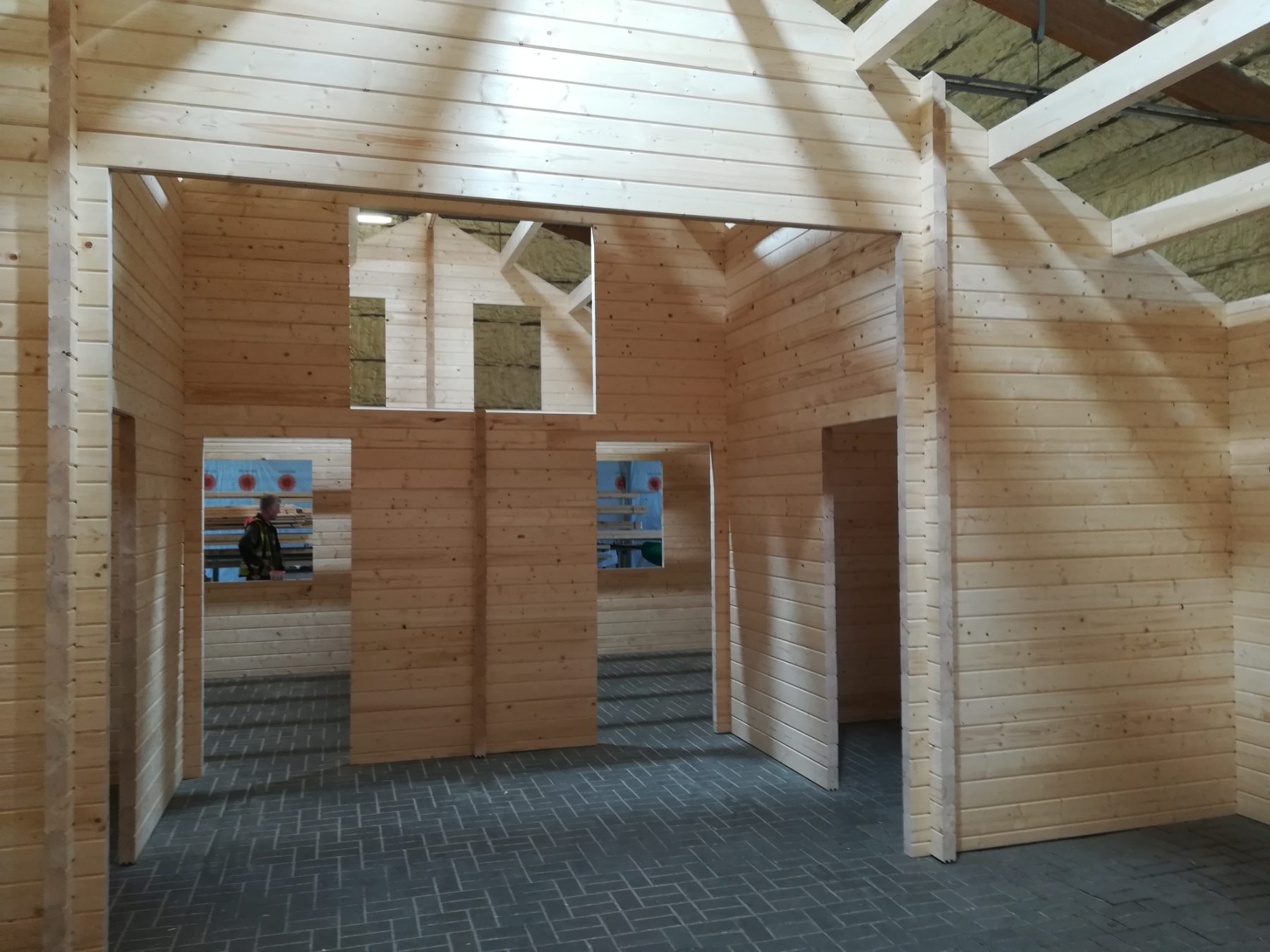
In log construction the wall is built from machined logs laid one course on another, with corners, joints and openings cut in the factory. Eurodita data sheets record the wall construction as interlocking tongue and groove joints. The same timber is the structure and the visible surface, inside and out.
In timber frame the structure is a frame, and the wall is completed by the layers fitted to it. That is a different product with a different supply scope; the three systems below are all log construction.
The three log systems Eurodita makes
| System | Wall | Profiles | Note |
|---|---|---|---|
| Solid log | One machined solid log per wall course | 19x100, 28x100, 34x100, 44x130, 58x130, 70x130 mm | A solid log model can be made in any of the 28, 34, 44, 58 and 70 mm profiles; the 19 mm profile is used only on the models catalogued with it. |
| Twin-skin | Two equal solid log skins per course with a cavity between them | 44-100-44, 58-50-58, 58-100-58 mm | The cavity takes insulation bought locally; offered per project. |
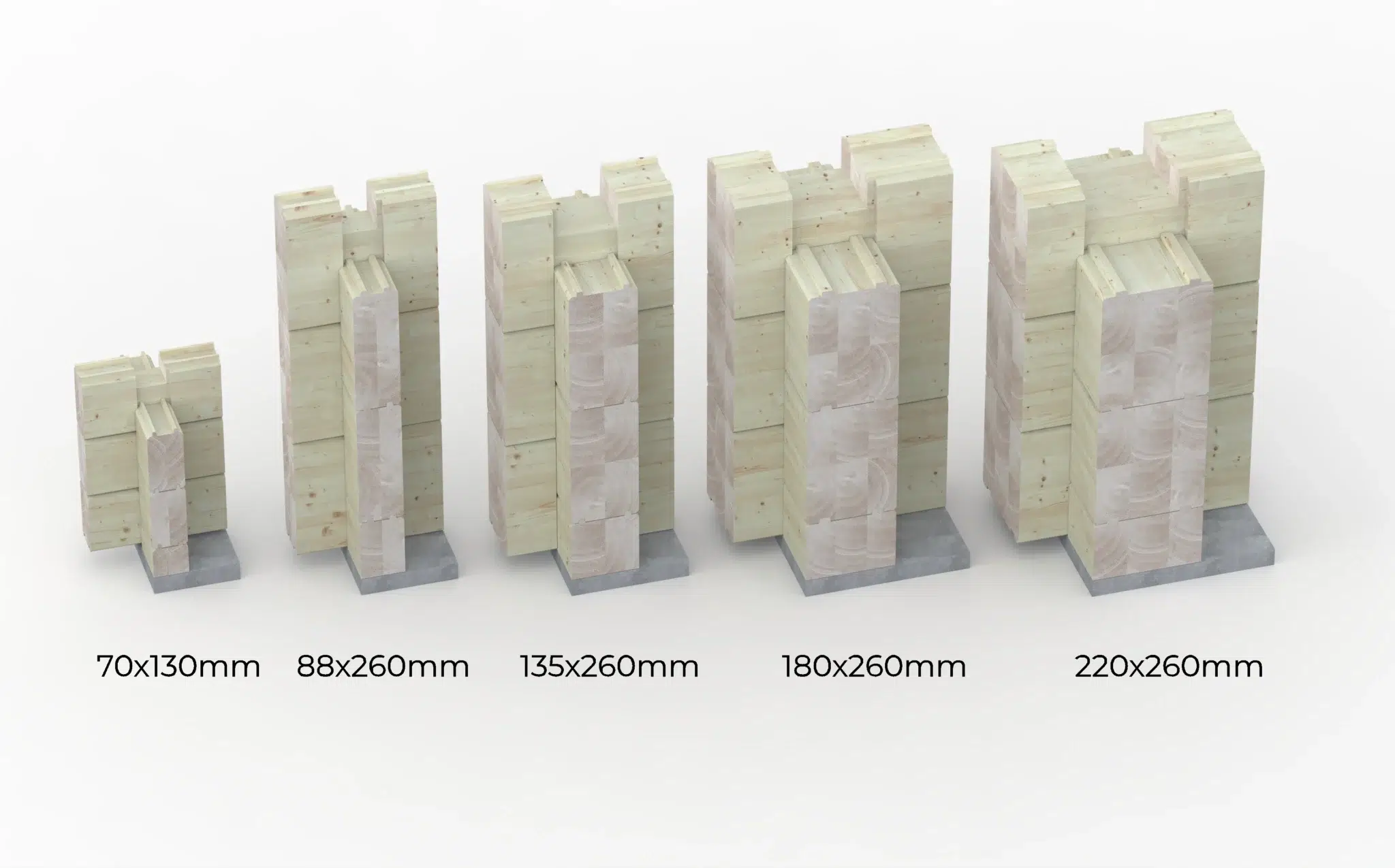
| Glulam | One machined glulam log per wall course | 70x130, 88x260, 135x260, 180x260, 220x260 mm | Glued, profiled and machined by Eurodita on one site; supplied only as part of a building kit. |
Wall type and thickness are chosen per project, by budget and by what is technically possible. A profile is written thickness first and log height second. Every building dimension Eurodita states is external.
What a log kit contains
A log building leaves the factory as a flat-packed kit: machined wall logs, floor bearers and floorboards, roof structure and roof boards, the timber joinery made in the same plant and, on solid log and twin-skin kits, the storm brace and anchor set. Insulation material, roof covering, foundations, utilities and interior fit-out are sourced locally; paint is outside the kit unless ordered.
Glulam walls do settle, but only minimally: in use the settlement is neither felt nor seen.
What the comparison cannot tell you
A wall thickness on its own establishes no thermal, fire, acoustic or structural performance of a finished building. Eurodita publishes measured U-values of the timber wall element alone, for the 28 to 220 mm profiles, on wall profiles; they are not a figure for a finished building and not a compliance result, and none is published for twin-skin.
Which construction suits a project is decided by the brief, the budget, the local rules and the designer. Structural calculations, where a project needs them, are carried out by external specialist partners; approvals stay with the buyer's local route.
Frequently asked questions
What is the difference between timber frame and log cabin construction?
In log construction the wall is built from machined logs laid in courses and joined at the corners, so the log is the wall. In timber frame the structure is a frame and the wall is completed by the layers fitted to it.
Which log wall systems does Eurodita make?
Three: solid log in six profiles from 19x100 to 70x130 mm, twin-skin in three build-ups from 44-100-44 to 58-100-58 mm, and glulam in five profiles from 70x130 to 220x260 mm.
Is a log wall warmer than a timber frame wall?
Eurodita gives no thermal comparison between the two constructions. A wall thickness on its own establishes no thermal performance of a finished building; measured U-values of the timber wall element alone are published for the 28 to 220 mm profiles.
Can a solid log model be made in glulam?
Wall type and thickness are chosen per project, by budget and by what is technically possible, so a solid log model can also be made in a glulam profile. Availability is confirmed in the quotation.
How to prepare an enquiry
Write the wall in full: the family and the profile or build-up, for example 58x130 mm solid, 44-100-44 mm twin-skin or 135x260 mm glulam. Add the model or drawing reference, the external dimensions, the joinery, the destination country and the quantity.
Eurodita replies with a written quotation in EUR, excluding VAT and delivery, EXW Eurodita factory by default. Installation is agreed per project; foundations and utilities are provided locally.