
Twin-Skin vs Standard Log Cabin: Insulation, Performance and Dealer Margins
- Home
- Twin-Skin vs Standard Log Cabin: Insulation, Performance and Dealer Margins
Introduction: The Insulation Challenge in Timber Construction
Across Europe, the UK, and beyond, demand for year-round habitable timber structures continues to accelerate. Municipal planning frameworks are increasingly receptive to timber-based residential and commercial buildings, and end customers are actively seeking alternatives to conventional masonry construction. For timber dealers, this represents a substantial market opportunity — but one that requires a thorough understanding of insulation performance and building standards.
Traditional single-wall log cabin construction, while proven for seasonal applications, faces inherent limitations when it comes to year-round thermal performance. A single thickness of solid timber, regardless of wall profile, cannot achieve the U-values required by modern building regulations for permanent habitation in most northern European climates.
Twin-skin construction — also referred to as double-wall or insulated cavity log construction — was engineered specifically to address this challenge. By combining two parallel log walls with an insulated cavity, this approach delivers thermal performance that meets or exceeds regulatory requirements while retaining the aesthetic and structural advantages of solid timber.
For dealers evaluating their product portfolio, understanding the technical and commercial differences between these two construction methods is essential. This guide provides a comprehensive comparison to inform product recommendations, customer consultations, and business strategy.
What is Twin-Skin Construction?
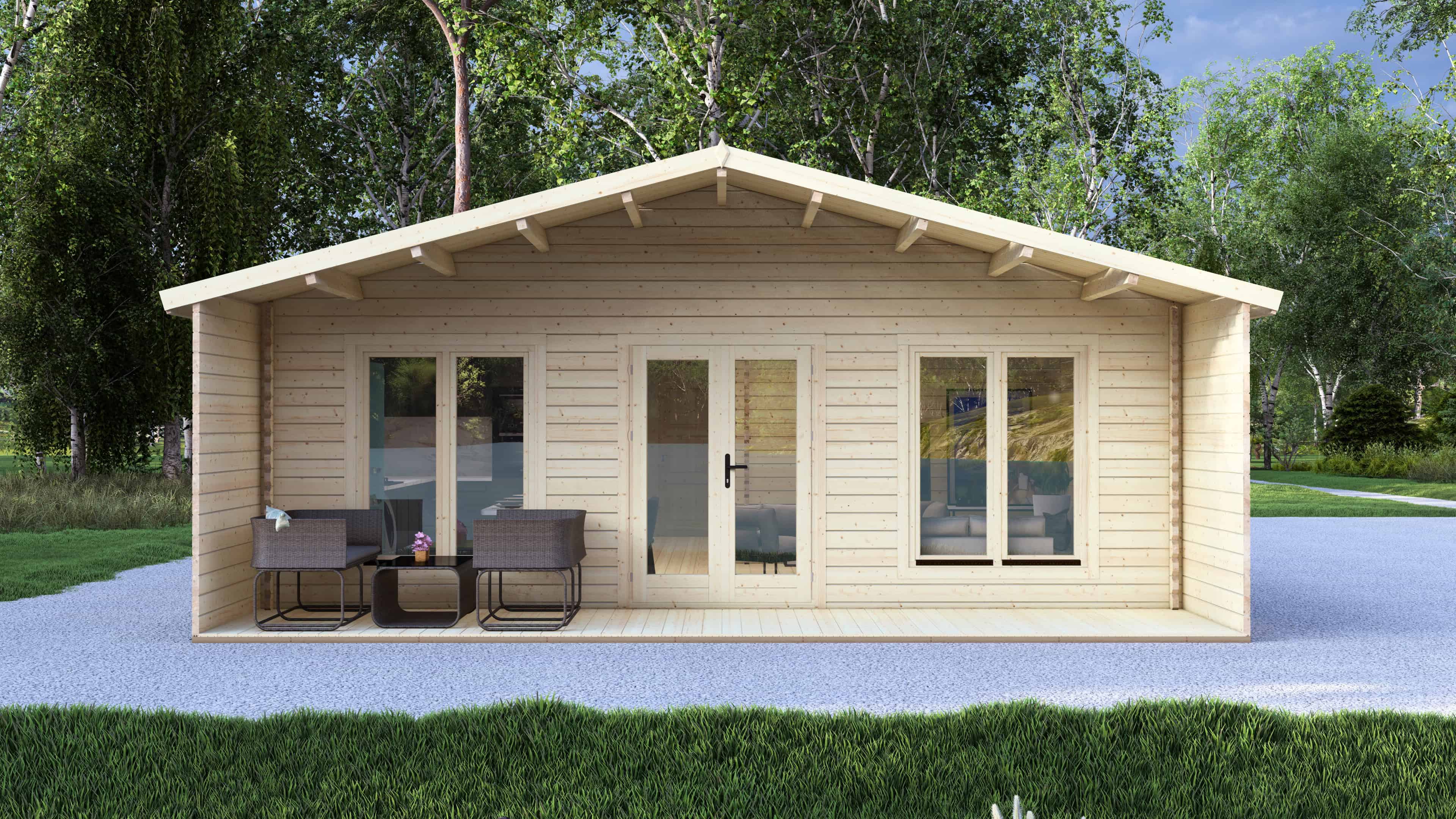
Twin-skin log cabin construction consists of two parallel walls of machined Nordic spruce, separated by an insulated cavity. This approach combines the structural integrity and natural aesthetics of solid timber with the thermal performance of modern insulated construction.
Key Components
- Outer wall: Typically 44mm Nordic spruce, machined with interlocking profiles for structural stability and weather resistance
- Insulated cavity: 50mm to 100mm gap filled with mineral wool, PIR (polyisocyanurate) boards, or equivalent insulation materials
- Inner wall: Typically 44mm Nordic spruce, providing a finished interior surface and additional thermal mass
- Vapour barrier: Installed on the warm side (interior) of the insulation to prevent moisture migration into the cavity
- Breathable membrane: Applied to the outer face of the insulation to allow moisture to escape while preventing water ingress
Total wall thickness ranges from 138mm (44+50+44) to 188mm or more (44+100+44), depending on the insulation specification. This layered approach eliminates the thermal bridging inherent in single-wall construction, where heat transfers directly through the solid timber from interior to exterior.
The cavity insulation dramatically reduces the U-value (thermal transmittance) of the wall assembly, bringing it in line with — or better than — the requirements of UK Building Regulations Part L and equivalent European standards. At the same time, the solid timber on both faces provides substantial thermal mass, moderating interior temperature fluctuations throughout the day.
Eurodita manufactures all twin-skin structures at its Kaunas facility, using Hundegger CNC machining to ensure precise interlocking profiles on both inner and outer wall sections. This precision is critical: in twin-skin construction, both walls must align perfectly to maintain structural integrity and insulation continuity.
Standard Single-Wall Construction
Standard log cabin construction uses a single thickness of machined Nordic spruce for the external walls. This is the traditional approach to timber cabin building, refined over centuries in Scandinavian and Baltic timber construction traditions.
Wall Thickness Options
Eurodita offers standard single-wall cabins in a range of wall thicknesses: 28mm, 34mm, 44mm, 70mm, 88mm, 88mm, and 112mm. Thicker walls provide greater structural rigidity, improved acoustic performance, and better thermal mass — though even the thickest single-wall option cannot match the insulation performance of a twin-skin assembly.
Thermal Characteristics
Solid timber has natural insulating properties. A 44mm spruce wall provides a U-value of approximately 2.5 W/m³K, while a 112mm wall achieves approximately 1.0 W/m³K. These values are adequate for seasonal use — garden offices used during warmer months, summer houses, storage buildings, and workshops. However, they fall significantly short of the 0.18–0.30 W/m³K required by UK Building Regulations Part L for habitable buildings.
Enhancement Options
Standard cabins can be enhanced with external cladding and insulation or internal insulation and plasterboard lining. These modifications improve thermal performance but add complexity, cost, and installation time. They also alter the aesthetic character of the building — either externally (with cladding) or internally (with plasterboard). For dealers, this creates a clear upgrade pathway: customers who initially consider a standard cabin for year-round use can be directed toward the purpose-engineered twin-skin option.

Technical Comparison Table
| Parameter | Standard (44mm) | Standard (70–112mm) | Twin-Skin (44+50+44mm) | Twin-Skin (44+100+44mm) |
|---|---|---|---|---|
| Total wall thickness | 44mm | 70–112mm | 138mm | 188mm |
| Typical U-value (W/m³K) | ~2.5 | ~1.0–1.6 | ~0.35–0.40 | ~0.22–0.28 |
| Thermal mass | Low | Moderate | High (two timber layers) | High (two timber layers) |
| Air tightness | Moderate | Moderate–Good | Excellent (sealed cavity) | Excellent (sealed cavity) |
| Condensation risk | Low (breathable wall) | Low | Very low (managed vapour barrier) | Very low (managed vapour barrier) |
| Sound insulation | Basic | Moderate | Good (cavity decouples walls) | Very good |
| Structural weight | Light | Moderate | Moderate–Heavy | Heavy |
| Foundation requirements | Simple base/bearers | Concrete pad or piles | Concrete slab or screw piles | Engineered concrete slab |
| Assembly complexity | Straightforward (2–4 days) | Moderate (3–5 days) | Intermediate (5–8 days) | Advanced (7–10 days) |
| Year-round habitation | Not recommended | Limited (with supplementary heating) | Suitable | Fully suitable |
| UK Part L compliance | No | No | Approaching (with upgrades) | Yes (meets wall U-value targets) |
| Typical applications | Storage, workshops, summer houses | Garden offices, holiday cabins | Home offices, granny annexes, holiday lets | Permanent residential, year-round holiday lets |
Thermal Performance Deep Dive
Thermal transmittance (U-value) is the single most important metric when evaluating wall construction for habitable buildings. It measures the rate of heat transfer through a building element — the lower the value, the better the insulation.
U-Value Comparison
A standard 44mm solid spruce wall achieves a U-value of approximately 2.5 W/m³K. This means heat escapes through the wall at roughly 8 to 10 times the rate permitted by UK Building Regulations Part L, which requires wall U-values of 0.18–0.30 W/m³K for new habitable buildings.
A twin-skin wall with 44mm outer wall, 50mm mineral wool cavity insulation, and 44mm inner wall achieves approximately 0.35–0.40 W/m³K. Increasing the cavity to 100mm with PIR insulation brings this down to 0.22–0.28 W/m³K — within the range required by Part L and equivalent European standards.
This is not a marginal improvement. Twin-skin construction reduces heat loss through walls by approximately 85–90% compared to standard 44mm construction. For end customers, this translates directly into reduced heating requirements and lower energy bills for year-round occupation.
Building Regulations Context
In the UK, any timber structure intended for permanent habitation (including granny annexes, holiday lets with year-round bookings, and permanent residential buildings) must comply with Building Regulations Part L. The wall U-value requirement is just one component — floor, roof, glazing, and air tightness standards also apply. Twin-skin construction addresses the wall component comprehensively, and when combined with appropriate floor insulation, insulated roofing, and double or triple glazing, delivers a building envelope that meets regulatory standards.
Moisture Management and Breathability
One of the distinctive advantages of timber construction is breathability. Solid spruce has a natural capacity to absorb and release moisture, moderating interior humidity levels. In twin-skin construction, this breathability is preserved on both the interior and exterior faces. The insulated cavity is protected by a vapour barrier (warm side) and breathable membrane (cold side), preventing interstitial condensation while allowing the timber walls to perform their natural moisture-regulating function.
This is a significant advantage over conventional insulated stud-frame construction, where the timber structure is entirely concealed behind plasterboard and cladding. In a twin-skin log cabin, occupants benefit from visible timber surfaces on both sides of every wall — the defining aesthetic advantage of log construction, combined with modern thermal performance.
When to Recommend Each Option
Standard Construction is Ideal For
- Garden offices (three-season use): Where the structure will be heated and used primarily from spring through autumn, standard 44mm or 70mm construction provides adequate comfort at a lower entry point
- Summer houses and entertaining spaces: Seasonal structures used for leisure during warmer months do not require high-performance insulation
- Storage buildings and workshops: Spaces where thermal comfort is secondary to weather protection and security
- Holiday cabins (seasonal operation): Properties used during spring and summer seasons in moderate climates
- Budget-conscious projects: Where the end customer requires a timber structure at the most accessible specification, standard construction delivers proven performance for seasonal applications
Twin-Skin Construction is Ideal For
- Year-round residential buildings: Any structure intended for permanent habitation requires insulation performance that only twin-skin (or equivalent) construction can deliver
- Granny annexes and ancillary dwellings: These buildings typically require Building Regulations approval and must meet Part L thermal standards
- Permanent holiday lets: Properties operated year-round (including winter bookings) require adequate insulation to ensure guest comfort and manage heating costs
- Home offices requiring Building Regulations compliance: Where the structure is classified as a habitable building rather than an outbuilding, twin-skin construction meets the regulatory threshold
- Cold climate installations: Markets in Scandinavia, northern Europe, Canada, and highland regions where ambient winter temperatures regularly fall below -10°C
- Premium market positioning: Dealers targeting the high-specification residential market benefit from offering twin-skin as their flagship construction method
Assembly and Installation Differences
Standard Construction Assembly
Standard log cabins are supplied as complete flat-pack kits with pre-machined, numbered components. A typical cabin (3x4m to 6x5m) can be assembled by a two-person team in 2 to 4 days, depending on the model and wall thickness. The interlocking log profiles are designed for straightforward stacking, and the assembly sequence follows a logical progression: floor frame, wall logs, gable ends, roof structure, roofing, and finally windows and doors.
The tooling requirements are minimal: standard hand tools, a rubber mallet for seating log profiles, a spirit level, and basic lifting equipment for roof beams. This simplicity is a significant advantage for dealers offering installation services, as it reduces labour costs and allows for efficient scheduling.
Twin-Skin Construction Assembly
Twin-skin assembly follows the same fundamental sequence but introduces additional stages. The outer wall is erected first, followed by installation of the breathable membrane. The insulation is then fitted within the cavity — this stage requires precision to avoid gaps that would create thermal bridges. The vapour barrier is applied, and the inner wall is then erected against it.
Assembly time for a comparable twin-skin cabin is typically 5 to 10 days, reflecting the additional stages and the care required for insulation and membrane installation. The skill requirements are higher: installers must understand vapour barrier continuity, insulation fitting techniques, and the structural implications of the double-wall system.
For dealers, this has direct business implications. Twin-skin installation commands a higher service fee, reflecting the additional time and expertise required. It also creates an opportunity to differentiate from competitors who offer only standard construction, positioning the dealership as a specialist in habitable timber buildings.
Dealer Business Perspective
From a commercial standpoint, twin-skin construction represents one of the most significant opportunities in the current timber building market. The business case extends well beyond the higher unit value of each order.
Order Value and Margin Structure
Twin-skin cabins command a substantially higher order value than equivalent standard models. The additional materials (double the wall timber, insulation, membranes, and additional fixings) and the engineering complexity contribute to this premium. For dealers, the absolute margin per unit is correspondingly higher, even where the percentage margin remains consistent with standard products.
Market Positioning and Customer Profile
Customers specifying twin-skin construction are typically pursuing a higher-value project: permanent residential, compliant annexe, or premium holiday let. These customers expect professional consultation, technical documentation, and in many cases a full installation service. They represent the premium segment of the timber building market and are less sensitive to price than volume buyers of standard cabins.
Portfolio Strategy
The most effective dealer approach is to offer both standard and twin-skin ranges as a coherent portfolio. Standard cabins serve as entry-level products and generate volume. Twin-skin products serve the premium and residential segment, generating higher value per transaction. This dual offering captures the widest possible market while creating a natural upgrade pathway: a customer who initially enquires about a standard garden office for year-round use can be guided toward the twin-skin specification that will actually meet their requirements.
Market data across Europe and the UK consistently indicates growing demand for habitable timber structures — a trend driven by planning policy changes, rising construction costs for conventional buildings, and increasing consumer awareness of timber as a sustainable construction material. Dealers who position their business to serve this demand with technically compliant products are best placed to capture market share.
Eurodita Twin-Skin Range
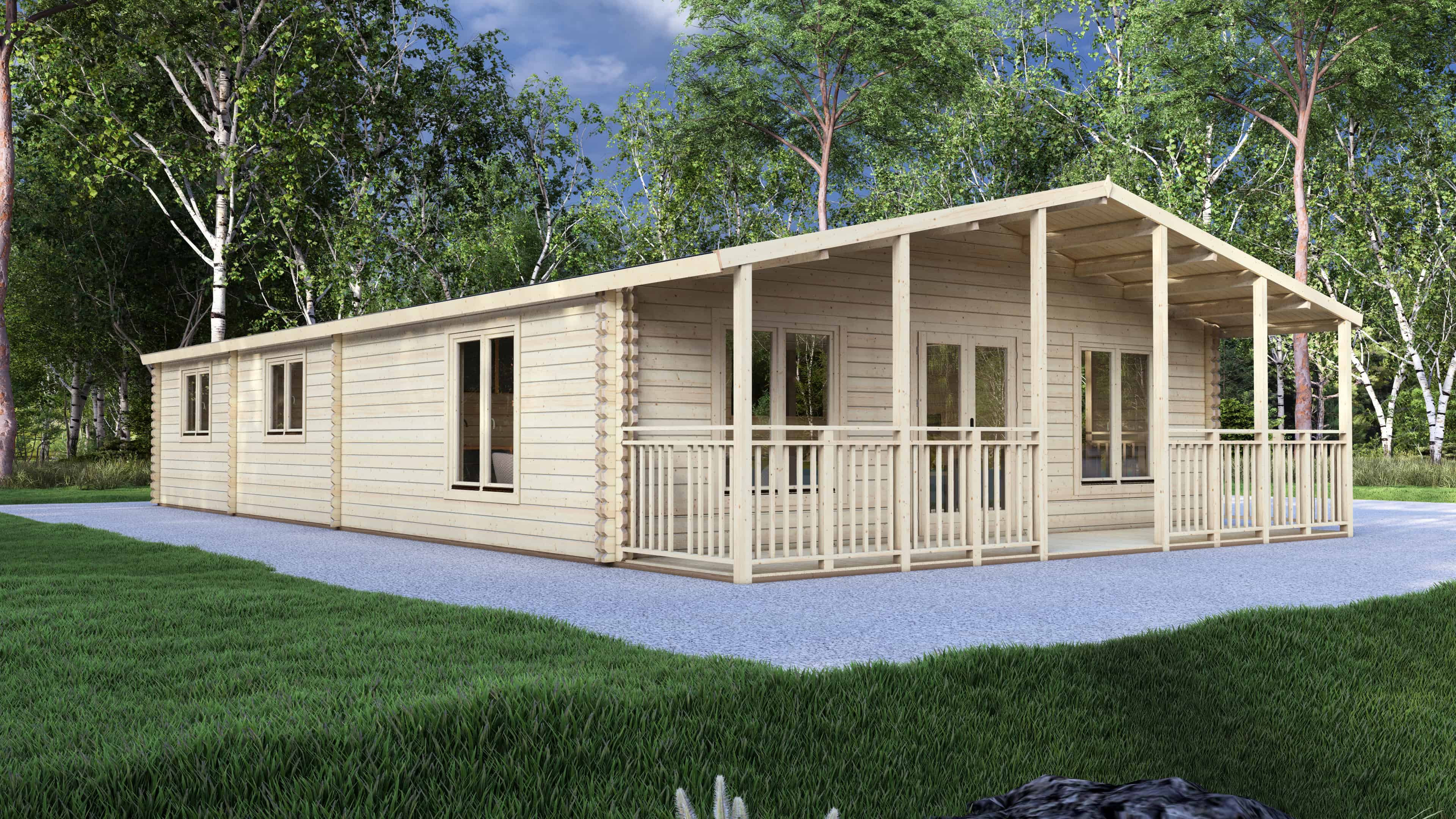
Eurodita manufactures 13 twin-skin models, ranging from compact structures (approximately 4x3m) to spacious four-bedroom residential buildings (up to 16x9m). Every model is manufactured at the Kaunas facility using Hundegger CNC machining for precision-cut interlocking profiles on both inner and outer wall sections.
Customisation Options
All twin-skin models are available with customisable specifications, including wall thickness configuration (44+50+44, 44+75+44, or 44+100+44), insulation material selection, glazing specification (double or triple), and interior layout modifications. Bespoke dimensions and configurations are available through the custom engineering department.
Private Label Supply
As with all Eurodita products, twin-skin cabins are available under private label arrangements. Partners receive unbranded products with their own documentation, branding, and specifications. This allows dealers to build their own brand identity in the habitable timber building market while benefiting from Eurodita’s manufacturing capacity and engineering expertise.
The standard cabin range provides matched product coverage for dealers seeking a complete portfolio from a single manufacturing partner. Contact the partner management team to discuss twin-skin specifications and private label options.
Frequently Asked Questions
What is a twin-skin log cabin?
A twin-skin log cabin uses two parallel walls of machined Nordic spruce (typically 44mm each) with an insulated cavity between them. This construction method combines the aesthetic and structural qualities of solid timber with the thermal performance needed for year-round habitation. Total wall thickness ranges from 138mm to 188mm depending on the insulation specification.
How much better is twin-skin insulation compared to standard?
Twin-skin construction reduces heat loss through walls by approximately 85–90% compared to standard 44mm construction. A standard 44mm wall has a U-value of approximately 2.5 W/m³K, while a twin-skin wall (44+100+44 with PIR insulation) achieves 0.22–0.28 W/m³K. This is the difference between a structure suitable for seasonal use and one suitable for permanent habitation.
Can standard log cabins be insulated later?
Standard log cabins can be upgraded with external cladding and insulation or internal insulation and plasterboard. However, these modifications add cost, complexity, and construction time. They also alter the visual character of the building — either the exterior timber appearance or the interior log wall finish. Where year-round habitation is the intended use, specifying twin-skin construction from the outset is more cost-effective and delivers a superior result.
Do twin-skin cabins meet UK Building Regulations?
Twin-skin cabins with 100mm cavity insulation can achieve wall U-values of 0.22–0.28 W/m³K, which meets the Part L requirement for walls in habitable buildings (0.18–0.30 W/m³K). Full Building Regulations compliance also requires appropriate floor insulation, roof insulation, glazing specification, ventilation, and air tightness testing. Twin-skin construction addresses the wall component comprehensively.
What is the typical U-value of a twin-skin log cabin?
With a 50mm mineral wool cavity, the wall U-value is approximately 0.35–0.40 W/m³K. With a 100mm PIR cavity, this improves to approximately 0.22–0.28 W/m³K. The precise value depends on the insulation material, installation quality, and any additional internal or external treatments.
Are twin-skin cabins suitable for permanent residential use?
Yes. Twin-skin construction was specifically developed for permanent residential applications. With appropriate insulation specification, foundation design, and building services, twin-skin log cabins provide comfortable year-round living environments that meet modern building standards. Eurodita manufactures models up to four-bedroom residential scale for this purpose.
How long does it take to assemble a twin-skin cabin?
Assembly time depends on the model size and crew experience. A compact twin-skin cabin (approximately 4x3m) typically requires 5–7 days for a two-person team. Larger residential models (10x8m and above) may require 8–12 days with a three or four-person team. These timeframes include insulation fitting and membrane installation, which are the additional stages compared to standard construction.
Can dealers order twin-skin cabins with custom specifications?
Yes. All Eurodita twin-skin models are available with customised wall thickness configurations, insulation specifications, glazing options, and layout modifications. Fully bespoke dimensions and designs are also available through the custom engineering department. Contact the partner management team to discuss requirements.
Compare wall systems for your market
Eurodita manufactures both twin-skin and standard log cabins under your brand.