
Germany is Europe’s largest market for timber buildings, with annual demand exceeding 400,000 units of garden structures and 25,000 residential timber homes. Starting a log cabin or timber building dealership in Germany requires Gewerbeanmeldung (business registration), understanding of Bauordnungsrecht, and a reliable EU-based wholesale manufacturer that supplies clear technical documentation.
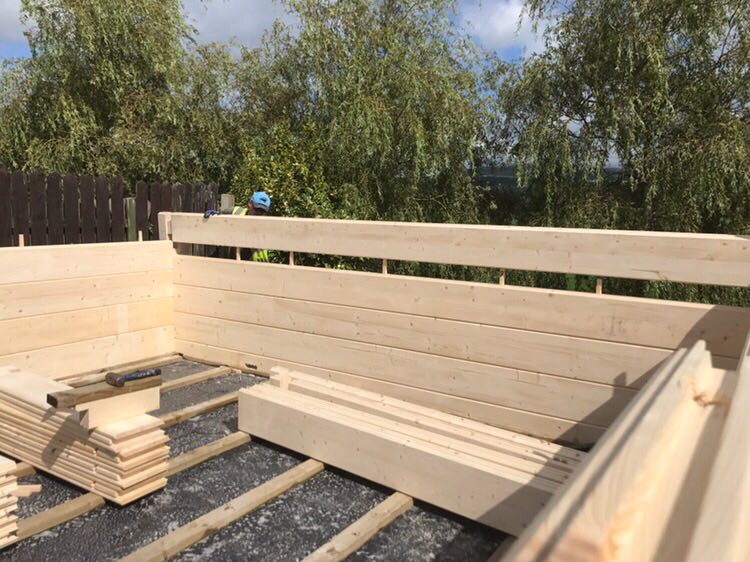
Germany’s Timber Building Market: Size and Opportunity (2026)
Key Facts: Log Cabin Dealership in Germany (2026)
- German timber building market: 400,000+ garden structures and 25,000 residential timber homes annually
- Startup investment: depends on the dealer’s own scale, showroom and marketing plan
- Turnover potential: set by the dealer’s own volume, pricing and market; Eurodita publishes no turnover forecast
- CE marking: generally needed for structural timber products covered by a harmonised European standard, such as strength-graded structural timber (EN 14081); confirm per product what the German approval route requires
- EU-based production: zero customs duties, road freight to Germany
- Key trade shows: Dach+Holz International, Ligna
- Consumer preference: documented wall build-ups, clear fire-safety information and specification support
Germany is Europe’s largest timber building market, with annual demand exceeding 400,000 garden structures and 25,000 residential timber homes. Starting a Blockhaus dealership requires a Gewerbeanmeldung (business registration), understanding of Bauordnungsrecht, and an EU-based manufacturer that supplies clear technical documentation. What a dealership costs to start and what it turns over depend on its own scale, range and pricing.
- Germany is the largest single market for timber buildings in Europe by volume and value
- Over 400,000 garden structures (Gartenhäuser) are sold annually, with log cabin and timber buildings representing approximately 40% by unit count
- Residential timber homes (Holzhäuser) account for approximately 19% of all new residential builds, the highest share in the EU
- German consumers are highly specification-literate: technical documentation, sourcing information and U-value data are expected in product information
- The Holzrahmenbau (timber frame) and Blockbohlenhaus (log cabin) markets are distinct, dealers typically choose one or the other
- E-commerce penetration is growing in the garden structure segment, but physical showrooms remain important for higher-value products
Legal Requirements for Setting Up a Business in Germany
Setting up a timber building dealership in Germany involves several administrative steps. The process is more structured than in the UK but is well-documented:
- Gewerbeanmeldung: Register your business with the local Gewerbeamt (trade office). Cost: approximately €20-€60. Can be done in person or online. Required before trading.
- Finanzamt registration: Register with the local tax office (Finanzamt) for a Steuernummer (tax number) within 4 weeks of starting. Required for invoicing.
- Umsatzsteuer (VAT): German VAT rate is 19%. You must register for VAT if turnover exceeds €22,000 in the first year or €50,000 thereafter. Register voluntarily from day one if selling to German businesses (input VAT reclaim).
- IHK membership: Most businesses automatically become members of the local Industrie- und Handelskammer (Chamber of Commerce). Annual fee applies based on turnover.
- Trade insurance: Betriebshaftpflichtversicherung (public liability) and Produkthaftpflicht (product liability) are essential. Budget €800-€2,500/year.
- GmbH vs Einzelunternehmen: Most small dealers start as Einzelunternehmer (sole trader) or GbR (partnership). A GmbH (limited company) provides liability protection but requires €25,000 share capital and more complex accounting.
Understanding German Building Regulations for Timber Structures
German building law (Bauordnungsrecht) is administered at state level. Key points for timber building dealers:
- Most garden structures up to 10-30m² (threshold varies by state) do not require a Baugenehmigung
- Structures over these thresholds require building permit applications, customers will need technical documentation from the manufacturer
- Habitable structures (Wohngebäude) must comply with GEG (Gebäudeenergiegesetz, the German energy efficiency law), U-values, insulation, and heating standards apply
- quality and documentation requirements should be confirmed per product and destination-market route
- Some states require a local architect (Architekt) to seal permit applications for larger structures
Full country-by-country guide: Log Cabin Building Regulations: EU Country Guide 2026.
Finding the Right Wholesale Manufacturer for the German Market
German buyers expect clear technical documentation, and public tenders and commercial buyers may specify certified timber where a project requires it. Check what your customers’ permit applications and tenders will require before you choose a manufacturer.
Key criteria for a German market manufacturer:
- Technical documentation for each structural product, matched to what the German approval route requires
- Certified timber where a buyer requires it, as an increasing number of German commercial buyers and public tenders do; confirm what documentation the manufacturer can supply for your order
- EU-based production, eliminates customs delays, simplifies EU logistics, and avoids post-Brexit supply chain complexity
- Technical documentation in English, German-market customers expect to see data sheets; a dealer can translate these
- No single fixed minimum order, so you can test the market with a scoped first order before committing to volume
- Glulam capability, glulam (Brettschichtholz) has strong acceptance in the German market for mid-to-premium products
Eurodita (Kaunas, Lithuania), with timber-building manufacturing experience since 1994 and approximately 12,000 standard catalogue timber buildings produced per year on average, supplies log cabins and glulam homes to trade partners in a number of markets, with order scope confirmed in each quotation.
Eurodita’s German Dealer Programme
Eurodita’s manufacturing facility in Kaunas, Lithuania is geographically well-positioned for German market supply:
- EU-to-EU logistics: No customs, no import duties, straightforward cross-border delivery
- Kaunas to major German cities: approximately 1,200-1,600km, transit confirmed per booking by road freight
- Private-label supply: documentation and quotation material in your branding, where agreed for the order
- Technical data sheets and drawings: available for the specified product, for use in your customers’ permit applications
- bespoke quotation: 3D render included for custom specifications
- Wall thickness range: 19, 28, 34, 44, 58 and 70 mm solid log; 70, 88, 135, 180 and 220 mm glulam, covering garden buildings through to residential
Marketing Your Log Cabin Business in Germany
German consumers research thoroughly before purchasing. Key marketing channels for timber building dealers in Germany:
- Google Ads (Google Deutschland): High-intent search traffic for “Gartenhaus kaufen”, “Blockhaus Händler”, “Holzhaus Anbieter”. CPC is competitive but quality traffic.
- SEO in German: If operating in Germany, German-language content is essential. Consider a German-language section of your website or a separate .de domain.
- Trade shows: Dach+Holz (Stuttgart, biennial), Ligna (Hanover, biennial), Haus-Garten-Freizeit (Leipzig, annual). Important for B2B contacts and brand visibility.
- Houzz Germany and similar platforms: Active market for home improvement and garden inspiration.
- Regional business directories: Gelbe Seiten, local IHK directories, still used by older German business buyers.
- Social media: German market responds well to Instagram for aspirational product imagery and YouTube for installation/product walkthrough videos.
Key takeaway: German buyers trust brands that communicate specifications clearly, back every certification claim with documentation for the specific order, and provide local language support. Invest in German-language content and documentation early.
Frequently Asked Questions
Do I need to be based in Germany to sell log cabins to German customers?
u003cpu003eNo. A dealership in another EU country can serve German customers. If you set up a permanent establishment in Germany, such as an office, warehouse or showroom, you will normally need to register the business locally and for German VAT. Cross-border sales can carry their own VAT obligations, and supplying with installation in Germany can create a German VAT liability even without an office there, so take advice from a German tax adviser (Steuerberater).u003c/pu003e
Is CE marking mandatory for log cabins sold in Germany?
u003cpu003eOnly for certain products. Under the EU Construction Products Regulation, CE marking and a declaration of performance apply to construction products covered by a harmonised European standard or a European Technical Assessment. Whether a particular cabin kit falls under that depends on the product and its conformity route. Eurodita makes no blanket CE-marking claim for its range, so any requirement for a German project is confirmed for the specific product and order. The building authority (Bauaufsichtsbehörde) can confirm what a permit needs.u003c/pu003e
What is the minimum investment to start a log cabin dealership in Germany?
u003cpu003eThere is no fixed figure. Eurodita publishes no price list, so the display-stock part of the budget comes from your written quotation, priced EXW Kaunas with VAT and delivery excluded. Add freight, a German-language website, initial marketing, trade registration and insurance. The legal form matters too: a GmbH needs share capital of at least EUR 25,000, at least half of it paid in before registration, while a UG can be formed with far less. A Steuerberater can help you cost the rest.u003c/pu003e
What trade terms does Eurodita offer German dealers?
u003cpu003eUnless a quotation states otherwise, prices are quoted in euros, EXW Kaunas, with VAT and delivery excluded. The default payment structure is 50% with the order and 50% before factory dispatch. Delivery can be quoted separately, and DAP is available on request where it suits the order. Between Lithuania and Germany there are no customs formalities, but the VAT treatment is confirmed for each transaction, and the order scope is fixed in the written quotation.u003c/pu003e
Related reading: Eurodita Glulam Homes Range | Bespoke Custom Log Cabins | How to Start a Log Cabin Dealership in the UK | About Eurodita, manufacturing since 1994, Kaunas, Lithuania